
How to Tell Window Types Apart: The Guide to Making a Professional Choice
At first glance, all new windows look the same: white frames, clean glass, and smooth handles. However, beneath the surface, there is a massive difference that you will notice in your energy bills and home comfort. Learn how to distinguish a professional-grade window from a mediocre one in two technical steps.
1. The Invisible Difference: CE Marking and Transmittance
The fastest way to distinguish a high-efficiency window from a standard one is by requesting its CE Marking. Don't focus on the design; look at the $U$-value (Thermal Transmittance).
This value indicates how much energy "escapes": the lower the number, the better the window.
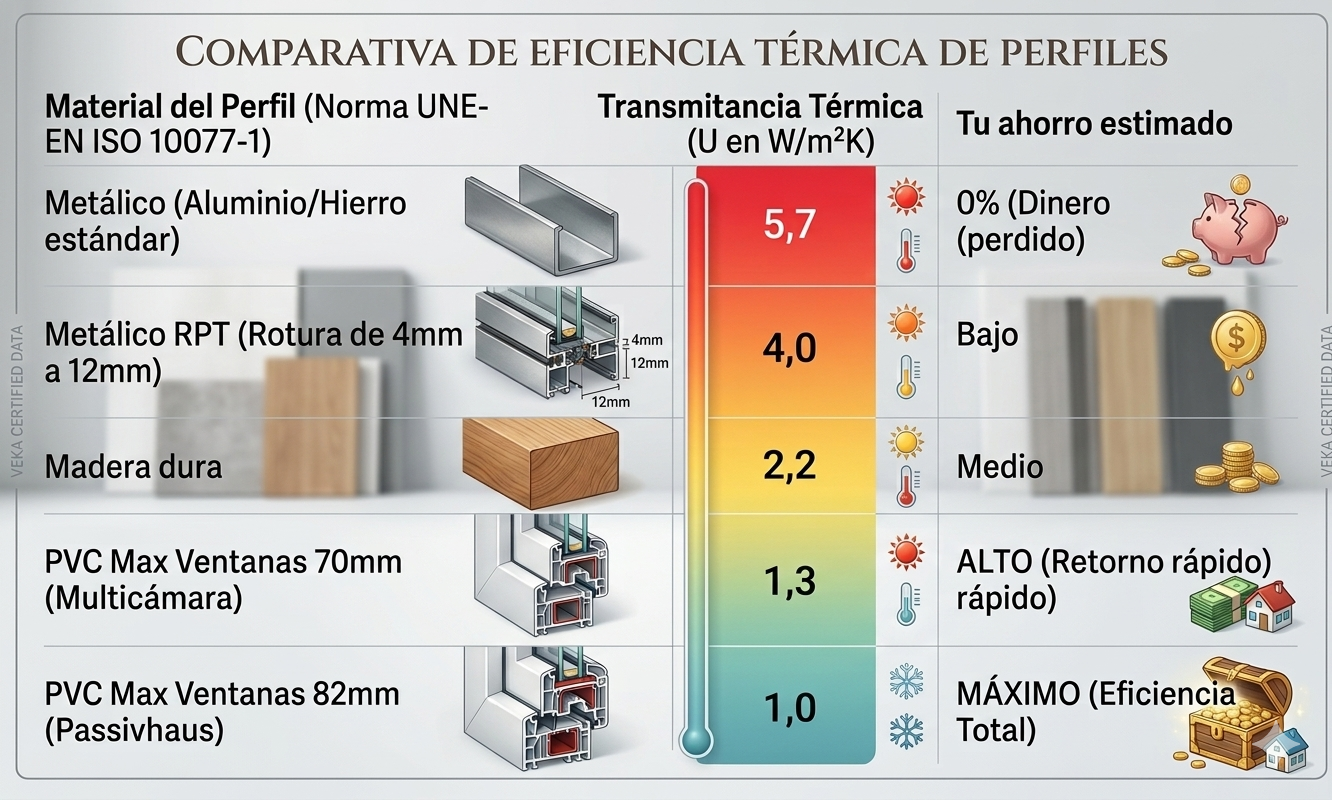 Source of Information: Technical values extracted from the IDAE (Institute for Energy Diversification and Saving) Technical Guide on Glass and Enclosures, based on UNE-EN ISO 10077-1 standards.
The Expert’s Secret: PVC is 1,100 times less conductive than metal. If the window frame feels "burning hot" in summer or "ice cold" in winter, you are looking at a low-efficiency material.
2. The Tangible Difference: The Profile's "DNA" (S-II-A)
To tell high-quality German PVC apart from low-cost alternatives, open the window and look for the code engraved on the side of the profile. For a window prepared for the Spanish climate, it must say S-II-A:
S (Severe Climate): Only the "S" stamp guarantees the window won't yellow or crack under extreme Mediterranean solar radiation.
II (Impact Resistance): Indicates the highest category of structural toughness and security.
A (Class A): This is the ultimate proof. Class A profiles have 3mm outer walls. Thinner profiles (Class B) warp over the years, causing the window to lose its airtight seal.
Express Service: Need it now? Our Express Order service delivers your White Series 70 windows (VEKA Quality) in just 7 DAYS.
Financiado por el Programa Kit Digital. Plan de Recuperación, Transformación y Resiliencia de España «Next Generation EU».
